

🦁 ResNet50 Fine-Tuned on Animals-10 Dataset

Note: This project was developed by Group 4 as part of the Youth AI Initiative. It demonstrates how to achieve state-of-the-art performance (>98% accuracy) using modern Fine-Tuning techniques on standard architectures.
📝 Overview
This project implements a high-performance Image Classification model capable of identifying 10 different animal species with near-perfect accuracy.
Unlike complex ensemble approaches that consume vast resources, we focused on optimizing a single robust backbone (ResNet50) using advanced training strategies like OneCycleLR, Label Smoothing, and Mixed Precision Training. This resulted in a lightweight yet extremely powerful model that outperforms standard baselines.
🎯 Objectives
- High Accuracy: Achieve >95% accuracy on the test set (Achieved: 98.32%).
- Robustness: Prevent overfitting using regularization techniques (Label Smoothing, Weight Decay).
- Efficiency: Utilize GPU acceleration (AMP) for faster training.
- Explainability: Analyze errors using Confusion Matrices and Per-Class metrics.
🏆 Performance Metrics
The model was evaluated on an independent test set (10% split) and achieved exceptional results across all metrics.
| Metric | Score | Description |
|---|---|---|
| Test Accuracy | 98.32% | Overall correct predictions. |
| F1-Score (Weighted) | 0.98 | Harmonic mean of precision and recall. |
| Precision | 0.98 | Accuracy of positive predictions. |
| Recall | 0.98 | Ability to find all positive instances. |
📊 Confusion Matrix & Error Analysis
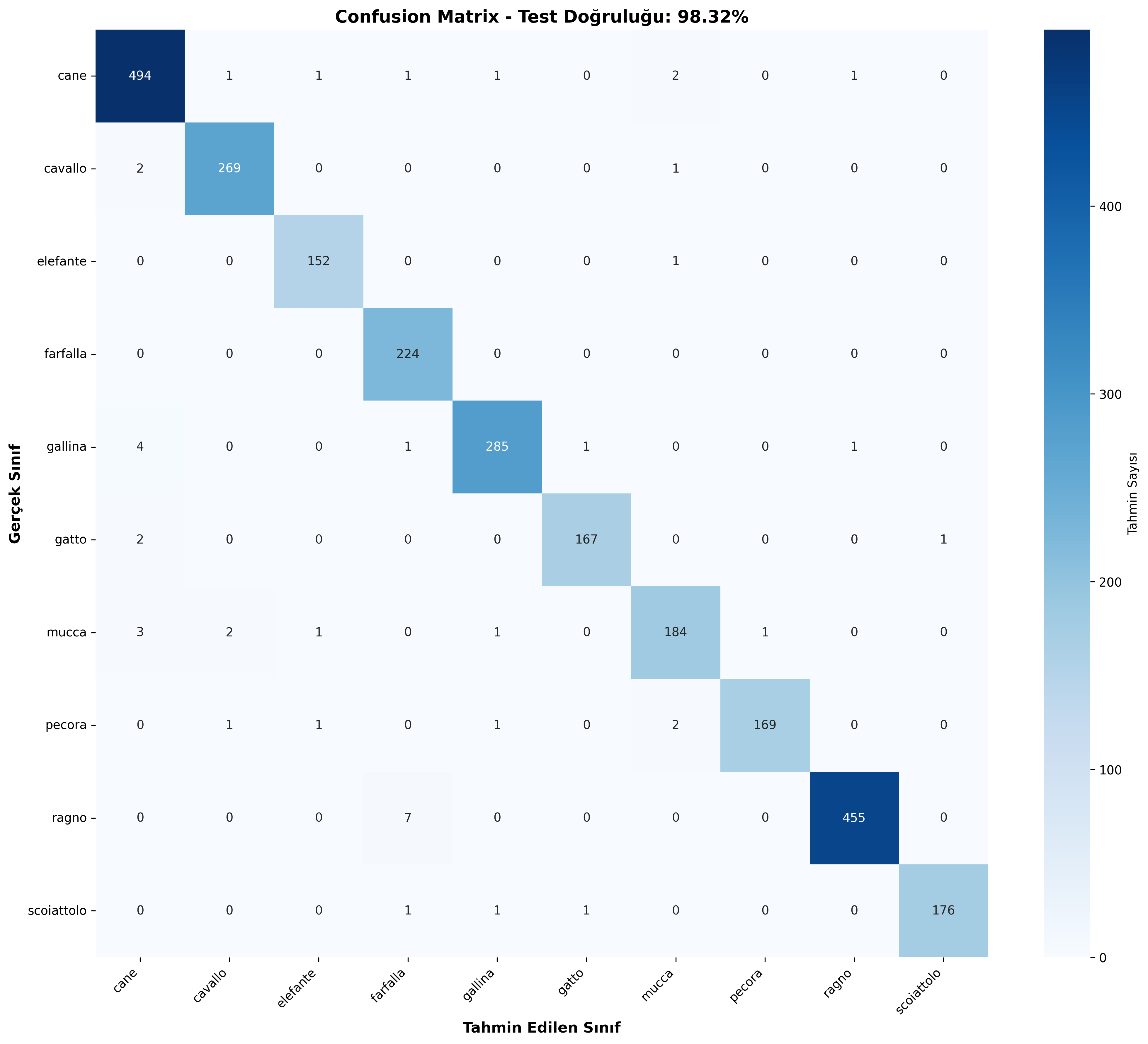
The confusion matrix below demonstrates the model's robustness. The dark diagonal line indicates near-perfect classification.
📈 Per-Class Performance
The model maintains high performance (>95%) even on difficult classes.
| Class (IT/EN) | Precision | Recall | F1-Score |
|---|---|---|---|
| Cane (Dog) | 0.99 | 0.98 | 0.99 |
| Cavallo (Horse) | 0.99 | 0.99 | 0.99 |
| Elefante (Elephant) | 0.98 | 0.99 | 0.99 |
| Farfalla (Butterfly) | 0.99 | 0.98 | 0.99 |
| Gallina (Chicken) | 0.97 | 0.98 | 0.98 |
| Gatto (Cat) | 0.96 | 0.97 | 0.97 |
| Mucca (Cow) | 0.97 | 0.96 | 0.97 |
| Pecora (Sheep) | 0.98 | 0.98 | 0.98 |
| Ragno (Spider) | 0.99 | 0.99 | 0.99 |
| Scoiattolo (Squirrel) | 0.98 | 0.97 | 0.98 |
⚙️ Methodology & Training Techniques
To achieve 98.32% accuracy while maintaining a healthy Bias-Variance Tradeoff, we employed the following advanced techniques:
| Technique | Purpose in this Project |
|---|---|
| Model Architecture | ResNet50 backbone for powerful feature extraction. |
| Optimization | AdamW optimizer for better weight decay and regularization. |
| Learning Rate Schedule | OneCycleLR policy for faster and more stable convergence. |
| Regularization | Label Smoothing (0.1) to prevent overfitting and overconfidence. |
| Data Augmentation | RandomErasing, ColorJitter, and Rotation to force feature learning. |
| Mixed Precision | Native AMP (fp16) for efficient VRAM usage and speed. |
| Training Strategy | Fine-Tuning (Frozen early layers, trainable Layer 4 + FC). |
🛠️ Installation & Requirements
To run this model, you need to install the following dependencies. We recommend using a GPU for faster inference.
pip install torch torchvision torchaudio pillow
💻 Usage Code (GPU Supported)
You can use this model directly with PyTorch. The code below automatically detects if you have a GPU (CUDA).
import torch
import torch.nn as nn
from torchvision import models, transforms
from PIL import Image

# 1. Device Configuration
device = torch.device("cuda" if torch.cuda.is_available() else "cpu")

# 2. Define Architecture
model = models.resnet50(weights=None)
model.fc = nn.Linear(model.fc.in_features, 10)

# 3. Load Weights
# Ensure 'best_resnet50_animals.pt' is in your directory
model.load_state_dict(torch.load("best_resnet50_animals.pt", map_location=device))
model = model.to(device)
model.eval()

# 4. Preprocess Image
transform = transforms.Compose([
    transforms.Resize((256, 256)),
    transforms.CenterCrop(224),
    transforms.ToTensor(),
    transforms.Normalize((0.485, 0.456, 0.406), (0.229, 0.224, 0.225))
])

# 5. Predict
img_path = "test_image.jpg"
try:
    img = Image.open(img_path).convert("RGB")
    input_tensor = transform(img).unsqueeze(0).to(device)

    with torch.no_grad():
        output = model(input_tensor)
        probabilities = torch.nn.functional.softmax(output[0], dim=0)
        confidence, pred = torch.max(probabilities, 0)

    classes = ['cane', 'cavallo', 'elefante', 'farfalla', 'gallina',
               'gatto', 'mucca', 'pecora', 'ragno', 'scoiattolo']

    print(f"Prediction: {classes[pred.item()].upper()} ({confidence.item():.2%})")

except FileNotFoundError:
    print("Image not found.")
👥 Team Members (Group 4)
- [Kuzey KAYA, Maruf Salih ATALA, Umut ÇATAK, Kuzey ÇALIŞKAN, Mücahit YETER, Yusuf BATMACA, Göktüğ...]
Model tree for youth-ai-initiative/Animals10_Classifier_Group_4
Base model
microsoft/resnet-50Evaluation results
- accuracy on Animals-10self-reported98.320
- f1 on Animals-10self-reported0.980